


When Feathers Fall

Years ago, I started writing a book, Color Your Spirit.
Part memoir, part spiritual guide, it followed my own journey out of hiding and toward a more authentic life, using color as the thread that connected it all. Each chapter explored a different color through a story from my life, then invited the reader to work with that color through reflection, ritual, creativity, or simply by bringing more of it into everyday life.
The idea was simple: sometimes we understand what we're going through before we have the words for it. And color gives us another language.
One of those chapters was built around a tiny purple feather.
And for years, it sat unpublished.
The Purple Feather
One chapter began at the end of a long, emotional day.
I had just finished my last day in a role that had consumed nearly fifteen years of my life in New York. "Job" doesn't really capture it. It had been a career, an identity, a community, and for a long time, the place where I measured my self-worth.
By the end, though, everything felt like it was collapsing.
If you know tarot, it was a Tower-card kind of day. Not a graceful ending. Not one of those transitions where you tie a bow around the lesson, hug everyone goodbye, and walk confidently toward your next chapter.
Everything I knew was coming apart.
I left work and started the roughly fifteen-minute walk home through brutally cold, single-digit temperatures and a New York snowstorm, crying the entire way.
Not delicate movie tears, either.
I call it an ugly cry.
The kind with tears, snot, saliva, and not a shred of dignity. There was nothing graceful about it. I was grieving the end of a chapter that had shaped much of my twenties and thirties, and, with it, a version of myself I wasn’t sure I knew how to be without.
Eventually, I reached my tiny apartment in East Harlem.
I stepped inside, exhausted, still crying, and began peeling off the layers.
Snow and ice began melting from my hair, face, clothes, and shoes, pooling on the floor.
And then something fell from my coat.
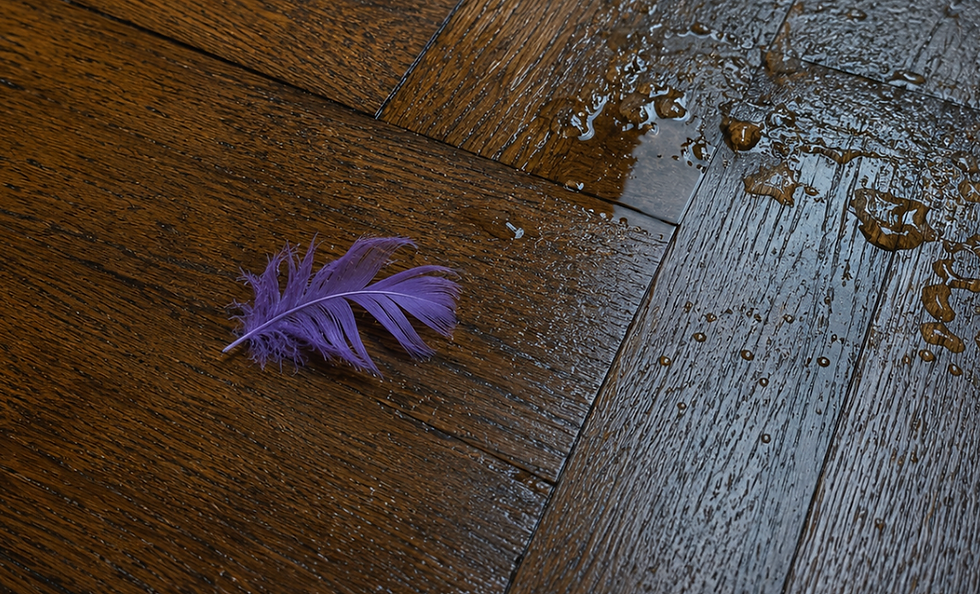
A small purple craft feather.
I watched it settle onto the floor.
It was the kind of feather you'd find in a bag of children's art supplies. Cheap. Synthetic. Completely ordinary.
Except there was no obvious reason for it to be in my pocket.
Yes, I had worked in a preschool environment, which would seem to offer an easy explanation. But I hadn't been doing arts and crafts. I hadn't been handling feathers.
I hadn't even been around the craft supplies for weeks.
Yet there it was.
Purple.
At that point in my life, I had already spent years studying angels, intuition, energy, and the spiritual symbolism of color. Purple had long represented transition, spiritual perspective, surrender, and the wisdom that can come when one chapter ends before the next has revealed itself.
And I had just walked home feeling like my entire life had unraveled.
I didn't need a booming voice from the heavens.
I had a purple feather resting on the wet parquet floor.
It was the kind of moment I could have easily ignored, but I chose to receive it as a sign.
Not a guarantee that everything was about to become easy.
Just a reminder that maybe I wasn't as alone in that moment as I felt.
I eventually folded the story into Color Your Spirit, and when the book didn't find a publisher, the purple-feather chapter went dormant in a folder on my computer for years.
The Inner Critic Answered First
Then I received an invitation to contribute to an upcoming anthology called Feathers: How Love Still Speaks After Goodbye.
You would think my immediate reaction would have been obvious.
I had a feather story.
They were making a book about feathers.
Send the feather story.
Done.
That is not what happened.
Instead, my inner critic arrived with a clipboard and a surprisingly well-organized presentation about why I was the wrong person for this.
The other stories, as I understood the project, centered largely around feathers as signs from loved ones who had died.
Mine didn't.
Nobody had died in my story.
My feather wasn't something I associated with a deceased loved one. I understood it as a sign from my angels during the ending of a career and an enormous chapter of my life.
That's not the same thing.
It doesn't belong.
They're looking for something else.
Your story isn't relevant.
And then, because apparently my inner critic likes supporting documentation:
Remember what happened the last time you tried to publish this?
That one landed.
Because doubt is especially persuasive when it has evidence.
The chapter had already been part of a book that didn't happen.
There was the proof.
Or at least, that was the story I told myself.
Still, I couldn't quite let the invitation go.
Eventually, somewhat begrudgingly, I said yes.
So I started pulling apart the old chapter and rebuilding it into a standalone essay.
You might imagine that saying yes silenced the critic.
It did not.
If anything, the closer I got to submitting the piece, the louder it became. I started picking the whole thing apart: the story, the fit, whether anyone would care, whether I was trying to make it belong somewhere it didn't.
And Then There Was Orange
And then one Sunday, while I was working on the piece, I went to do laundry.
Nothing mystical about that.
I was pulling clothes from the dryer, mentally picking apart the essay yet again, when I grabbed a tangled wad of laundry.
And then, seemingly out of nowhere, something popped loose.
It floated down.
Slowly.
Right in front of me.
Another craft feather.
Orange.
I watched it drift toward the floor and had one of those moments when your brain needs an extra second to catch up with what your eyes have already seen.
Because now the easy explanation for a feather was gone.
I hadn't worked in a preschool for four and a half years.
I wasn't surrounded by children's art projects anymore.
I hadn't been using craft feathers.
And somehow, at the exact moment I was mentally listing all the reasons I shouldn't be writing about the first feather, another one came floating out of my laundry.
The timing was absolutely ridiculous.
But I took note of the color.
Orange.
And that changed the moment for me.
In the way I work with color, orange carries creativity, passion, possibility, enthusiasm, and the willingness to follow inspiration before you know exactly where it will lead.
The first feather had appeared when I needed to let go.
The second appeared when I was trying to talk myself out of creating.
Purple had met me at an ending.
Orange found me at the edge of another beginning.
A different feather.
A different color.
A different moment.
But somehow, the message felt remarkably similar.
Keep going.
I don't know where that orange feather came from.
And I don't need to.
I don't think every strange thing that happens is supernatural. I don't think every feather is a message. Sometimes a feather is just a feather.
But I've also stopped believing that something has to be objectively provable before I'm allowed to find meaning in it.
Signs aren't proof. They're permission.
What it did was interrupt me long enough to hear something quieter than the critic.
And what I heard was:
Share it.
Not because it perfectly matches every other story.
Not because you know it will be well received.
Not because you've eliminated the possibility of rejection.
Share it because somebody might need it.
That realization has stayed with me.
Because I wonder how often we all do this to ourselves.
How often do we feel pulled toward something and immediately begin building the case against it?
A job catches our attention.
I'm not qualified enough.
Someone invites us into a room.
I'm not really one of those people.
We want to start something.
Someone else is already doing it better.
We want to write, paint, travel, speak, apply, love, change careers, go back to school, start over.
And before the world gets the opportunity to tell us yes or no, we decide the answer for it.
Sometimes we become so afraid of hearing no that we start saying it for other people.
I almost did that with this story.
My concern wasn't completely irrational. My story really was different from many of the stories the anthology was seeking. But somewhere along the way, "my story is different" had quietly turned into "my story doesn't belong."
A no from one door is information about that door. It is not a verdict on you.

Where Are You Saying No for Someone Else?
There may be an invitation sitting somewhere in your life right now.
Maybe it's obvious.
Maybe it's something quieter that keeps returning to your thoughts even though you keep explaining it away.
You don't have to call it intuition.
You don't have to call it the universe.
You don't have to believe in angels or signs or anything else I believe.
Just notice what keeps asking for your attention.
Then try this.
1. What is the invitation?
Write it down without immediately qualifying it.
I want to apply for that position.
I want to start writing again.
I want to ask if I can be included.
I want to take the class.
I want to show someone my work.
I want to make a change.
Don't worry yet about whether it is practical, likely, impressive, or sensible.
What are you being drawn toward?
2. What is your inner critic saying?
Let it talk.
Write down the argument.
You're not experienced enough.
You're too old.
You're too late.
They want somebody else.
You tried before.
People will think this is ridiculous.
You don't belong there.
Don't soften it.
The point isn't to pretend the voice doesn't exist.
It's to get it out of your head, where it can sound like unquestionable truth, and onto a page where you can actually look at it.
3. Separate the fact from the story.
Grab a notebook, or open a blank note on your phone, and draw a line down the middle of the page.
On one side, write WHAT I KNOW.
On the other, write WHAT I'M ASSUMING.
Maybe:
What I know: I don't have every qualification listed.
What I'm assuming: They would never hire me.
Or:
What I know: My last submission was rejected.
What I'm assuming: My writing isn't good enough.
Or:
What I know: I would be new to this group.
What I'm assuming: Everyone will wonder why I'm there.
Fear often hides in the second column while pretending it belongs in the first.
4. Ask one different question.
Instead of:
What if they say no?
Try:
What if I stopped answering for them?
You don't have to convince yourself they'll say yes.
That's not the work.
The work is giving them the opportunity to answer.
And giving yourself the opportunity to be surprised.
A Little Permission
You don't need a craft feather for this part.
Just find something orange.
Anything.
An orange from your kitchen. A candle. A sticky note. A sweater. A flower. A pen. Pull up an orange square on your phone if that's what you have.
Let it represent creativity, possibility, and movement.
Hold it or place it somewhere you can see it.
Think about the invitation you identified.
Then say, aloud if you can:
I don't need to know where this leads to answer what is calling me now.
Take a breath.
Then ask yourself:
What is one action I can take in the next 24 hours before my inner critic decides the answer for me?
Make it small.
Send the email.
Submit the application.
Open the document.
Ask to come along.
Make the appointment.
Share the idea.
Register.
Say yes.
You aren't promising yourself an outcome.
You're simply refusing to reject yourself in advance.
My first feather appeared on the night a life I had known for fifteen years ended.
Years later, another appeared while I was trying to decide whether an old piece of that life was still worth sharing.
Maybe neither feather changed anything.
Maybe both did.
What I know is that I kept them.
And I kept going.
The purple feather reminded me that an ending could be survived.
The orange one reminded me not to let that ending decide what happened next.
Maybe that is what both feathers were asking of me.
And maybe there is something in your life asking the same of you.
Feathers: How Love Still Speaks After Goodbye
The purple feather story eventually became The Feather in My Pocket, my contribution to the upcoming anthology Feathers: How Love Still Speaks After Goodbye.
If you have a feather story of your own, the anthology is currently accepting submissions.
Maybe your story has also been waiting for a different room.
Explore Angelic Color
Purple and orange carry very different energies in my work, and their appearance at these two moments is part of what made the experience so meaningful to me.
If you'd like to explore the spiritual meanings I associate with different colors and simple ways to bring their energy into everyday life, visit my Angel Color Guide


Comments